
Orthopaedic Surgeon Protection: Unveiling Splash Exposure Risks in Surgery
A literature review on why upper-face protection is still the weakest link in the OT
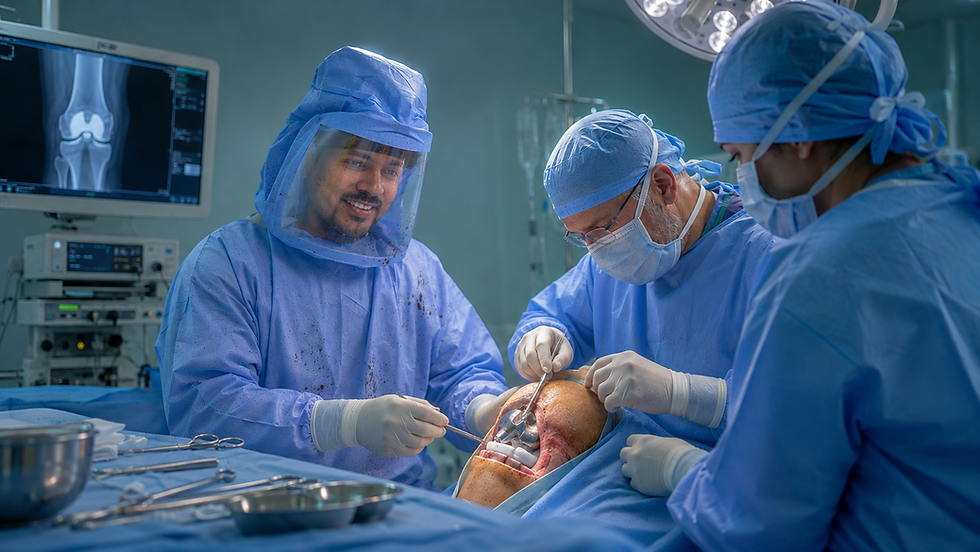
The exposure we stopped noticing
Ask an orthopaedic surgeon what they were exposed to during a total knee replacement, and you will usually get a shrug. Ask them to hold their mask and eyewear up to the light at the end of the case, and the answer changes.
The literature has been asking that question with better instruments than the naked eye – and the results are consistently worse than surgical teams assume.
A six-centre study of 600 face shields examined post-operative shields both visually and with leucomalachite green staining. Visual inspection found blood spatter on about half of them. Chemical staining found it on two-thirds. The gap between those two numbers is the entire problem: a third of contaminated shields looked clean.
Broken down by role, the lead surgeon's shield was contaminated in roughly 8 out of 10 cases, the first assistant's in about 7 out of 10, and the scrub nurse's in nearly half. By speciality, orthopaedics sat in the high-risk band alongside cardiovascular and neurosurgery. This highlights the urgent need for measures like Orthopaedic Surgeon Protection to mitigate these risks.
A separate single-surgeon prospective series over 12 months found blood and body-fluid splash on protective eyewear in about 45% of procedures and on the mask in about 24%. Work in spine surgery — where burrs, osteotomes and high-speed instrumentation are routine — reported splash rates roughly double those figures, which is exactly what you would predict when you replace a scalpel with a rotating tool at 70,000 rpm.
Why orthopaedics is the worst offender
Three mechanisms, all mechanical, all specific to bone work:
Bone debris as ballistic ejecta. Sawing, reaming, broaching and burring do not produce a gentle mist. They produce a fan of bone slurry, marrow, fat and irrigant travelling at the tip velocity of the instrument. Unlike an aerosol, this material is not carried by airflow — it is launched. Laminar flow does not help you. The distance from the cut to the visor in a hip or knee is 40–60 cm on a good day.
Pulse lavage and irrigation. Any device that pressurises fluid against tissue converts that fluid into droplets. Splash guards help. They do not eliminate the problem, which is why the irrigation literature keeps generating papers on face contamination.
Duration and volume. Splash contamination correlates with operative time and blood loss. A revision arthroplasty is not a 40-minute case.
The part nobody puts in the audit
Mucous membrane exposure – conjunctiva, nasal, oral – is a recognised transmission route for bloodborne pathogens, and it is the exposure route that is least likely to be reported. A needlestick generates an incident form. A droplet in the eye that the surgeon blinks away generates nothing at all.
The consequence is a systematic under-count. Hospital exposure registers capture sharps injuries well and splash exposures badly, which means the institutional risk picture used to justify PPE spending is built on the wrong denominator.
And yet, uptake of proper upper-facial protection has historically been reported as low — one figure in the literature puts routine face-shield use as low as 4% in some settings. The stated reason, over and over, is not cost. It is discomfort.
Discomfort is an engineering problem, not a behavioural one
This is the finding that should reorient how we think about protective equipment. Compliance failure in the OT is rarely a knowledge failure. Every surgeon in the room knows what hepatitis C is. They stop wearing the shield because it fogs, because it dims the field. After all, the strap gives them a headache by hour three. After all, they cannot hear the anaesthetist through it. After all, it weighs on the cervical spine during a long revision.
Every one of those is a specifiable, testable, solvable design requirement:
COMPLAINT | DESIGN REQUIREMENT |
Fogging | Positive airflow across the inner visor surface; anti-fog coating validated after repeated disinfection |
Dim field | Visor optical class controlled; light transmittance and haze specified, not assumed |
Neck fatigue | Total mass and, more importantly, centre of mass kept close to the cervical axis |
Can't hear / can't be heard | Acoustic path designed in, not left as a by-product of the shell |
Heat and CO₂ build-up | Airflow rate matched to metabolic load, exhaust path that does not recirculate |
The literature keeps telling us that PPE that is not worn provides zero protection. The engineering response is to stop treating comfort as a luxury feature and start treating it as the primary determinant of clinical effectiveness.
Setting the Standard for Orthopaedic Surgeon Protection
A protective headgear system that actually gets worn for a four-hour revision has to satisfy a brief that reads more like aerospace than like a disposable mask:
Full-face barrier covering the orbital, paraorbital and mask regions — because the splash data shows contamination distributed across all three
Sustained airflow that keeps the visor clear and the wearer thermally comfortable for the full duration of the longest case, not the average one
Optical quality that a surgeon does not fight against
Ergonomics that survive hour four
Disinfectability, because a helmet that cannot be cleaned becomes a reservoir
That is the brief we worked to when we designed the Vizbl Surgical Helmet — a full-face powered protective system built for long-duration arthroplasty and spine work, with airflow, mass distribution and visor optics treated as clinical performance parameters rather than styling. If the reason surgeons take the shield off is comfort, then comfort is the safety feature.

Comments