
Diathermy Plume: Understanding Surgical Smoke Risks and Mask Limitations
What the occupational-hygiene literature says about cautery smoke — and what PPE can and cannot do about it

A quantified hazard, an unregulated exposure to Diathermy Plume
Diathermy has been in routine use for a century. Nobody in the OT thinks twice about the smell.
The measurement data suggests we should. When electrocautery or argon plasma coagulation thermally decomposes tissue, particle counters in the operative field have recorded number concentrations exceeding 100,000 particles per cm³ in the 10 nm to 1 µm range. The mean aerodynamic particle size from electrocautery has been characterised at around 0.07 µm — laser coagulation produces larger particles (~0.31 µm) and ultrasonic devices larger still (0.35–6.5 µm).
NIOSH's own hazard control guidance is unambiguous about composition: the plume contains toxic gases and vapours, including benzene, hydrogen cyanide and formaldehyde, along with bioaerosols, cellular material, including blood fragments, and viruses. Viable organisms have been recovered from the plume – Staphylococcus aureus, Neisseria, and Corynebacterium species. HPV and HBV DNA have been detected in the plume under both experimental and clinical conditions. Case reports of laryngeal papillomatosis in theatre staff have been accepted as an occupational disease in at least one European jurisdiction.
The honest counter-argument
Good faith requires stating it. A 2024 critical review argued that the risks have been overstated: that measured pollutant levels in the breathable air of the OT are repeatedly low and that viral transmission via electrocautery remains unproven. Peak plume concentration is highly localised — it collapses within seconds under an effective air-handling system.
But note carefully what that concession does and does not say. It says the room is fine. It says nothing reassuring about the person whose face is 30 cm from the point of production, breathing the peak hundreds of times a year, for a thirty-year career. Which is why AORN, NIOSH, OSHA, AST and ANSI have all converged on the same recommendation: use local exhaust ventilation, and do not rely on general room ventilation to protect the operator.
Now the uncomfortable part about PPE
A standard surgical mask does not filter a 0.07 µm particle. It is a fluid barrier and a droplet barrier. It was never a respirator and does not behave like one. Assuming otherwise is the single most common misconception in the OT.
A surgical helmet is not a respirator either, unless it is explicitly designed, filtered and certified as one. A powered helmet with an unfiltered or coarsely-filtered air intake moves air past your face very pleasantly. It does not necessarily remove ultrafine particulate from it.
Any vendor who sells you PPE as a substitute for source-capture evacuation is selling you a comfortable way to be exposed.
The correct model: layered controls
The occupational-hygiene hierarchy is not a menu. It is a sequence:
Elimination / substitution — lower power settings, non-thermal techniques where clinically appropriate.
Engineering controls — smoke evacuation at the source. The literature is explicit that a smoke evacuator held more than ~2 inches (5 cm) from the point of production offers minimal protection. This is the single highest-yield intervention available, and it is chronically under-used, largely because of noise and cost.
Administrative controls — mandatory-evacuation policies. Several institutions have moved to blanket mandates for all electrocautery procedures; several US states have legislated it.
PPE — the last line, not the first. Correctly specified filtration media, correctly sealed, correctly worn.
What this means for headgear design
If PPE is the last line, it should at least be an honest one. That produces a short, hard specification:
Filtration media specified against the actual particle size distribution, with efficiency stated at the most-penetrating particle size — not a vague "HEPA-grade" claim on a datasheet.
Airflow path that never recirculates unfiltered theatre air across the wearer's breathing zone.
Sealing at the hood interface, because unsealed protection is a fashion accessory.
Filter service life is stated in operating hours, and a filter that can actually be changed by theatre staff without tools.
Acoustic design — a helmet quiet enough to work in makes it far more likely the team will tolerate the smoke evacuator running at the same time, the intervention that actually matters most.
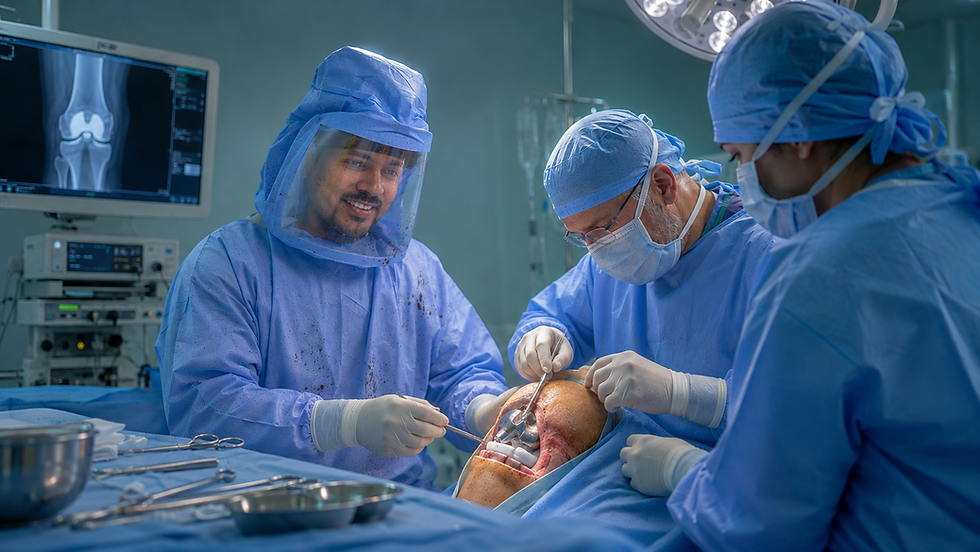
The Vizbl Surgical Helmet was specified around the recognition that headgear is not the primary control for surgical smoke — evacuation at source is — and that the most useful thing a helmet can do is provide honest, characterised filtration for the ballistic and bioaerosol fraction while being quiet and comfortable enough that nobody in the room reaches over and switches the evacuator off. Protect the operator. But protect them with the right control, in the right order.
Comments